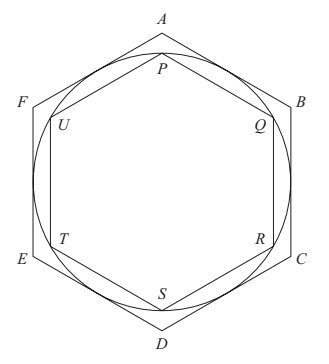
Each side of the smaller hexagon PQRSTU is a chord of the circle.
By considering perimeters, show that 2 < π < 2√3
This interesting GCSE geometry question asks you to prove an inequality about π using the perimeters of two regular hexagons related to a circle. Let's work through it step by step.
Understanding the setup
We have:
A circle with radius r cm
A larger regular hexagon (ABCDEF) whose sides are tangents to the circle (it's circumscribed around the circle)
- A smaller regular hexagon (PQRSTU) whose sides are chords of the circle (it's inscribed in the circle)
flowchart TD
    subgraph "Diagram Setup"
        C["Circle radius r"] --> H1["Larger hexagon: sides are tangents"]
        C --> H2["Smaller hexagon: sides are chords"]
        H1 --> P1["Perimeter > Circle circumference"]
        H2 --> P2["Perimeter < Circle circumference"]
    end
Key facts about regular hexagons
Before we start calculating, let's recall some important geometry:
A regular hexagon can be divided into 6 equilateral triangles
For a hexagon inscribed in a circle (vertices on the circle), each side length equals the radius of the circle
- For a hexagon circumscribed around a circle, we need to use trigonometry to find the side length
Step 1: Perimeter of the smaller hexagon (inscribed)
The smaller hexagon PQRSTU has its vertices on the circle. Each side is a chord.
Important fact: In a regular hexagon inscribed in a circle, the side length equals the radius.
Why? If you draw lines from the centre to all vertices, you get 6 equal triangles. The angle at the centre for each triangle is 60° (360° ÷ 6 = 60°). Since the two radii are equal, these are isosceles triangles with 60° at the centre, making them actually equilateral triangles. Therefore, each side of the hexagon equals the radius.
So: Each side = r cm
Perimeter of smaller hexagon = 6 × r = 6r
Step 2: Perimeter of the larger hexagon (circumscribed)
The larger hexagon ABCDEF has sides that are tangents to the circle.
flowchart TD
    subgraph "Circumscribed Hexagon Geometry"
        O["Centre O"] -->|radius r| T["Tangent point"]
        T --> A["Vertex A"]
        T --> B["Vertex B"]
        O -->|perpendicular| T
        A -->|tangent| T
        B -->|tangent| T
    end
Consider one of the 6 identical triangles formed by drawing lines from the centre to:
Two adjacent vertices of the hexagon
- The point where the side touches the circle (tangent point)
The angle at the centre is 60° (360° ÷ 6 = 60°), so we have half of this in our right-angled triangle: 30°.
We have a right-angled triangle where:
The angle at the centre is 30°
The side opposite this angle is half the side length of the hexagon (let's call half the side length = x)
- The side adjacent to this angle is the radius r
Using trigonometry (SOH CAH TOA):
tan(30°) = opposite/adjacent = xr
We know that tan(30°) = 1√3
So: 1√3 = xr
Therefore: x = r√3
Since x is half the side length of the hexagon:
Full side length = 2x = 2r√3
Perimeter of larger hexagon = 6 × (2r√3) = 12r√3 = 4r√3 (after rationalising: 12√3 = 4√3)
Step 3: Relating perimeters to the circle's circumference
Now think about the circle itself. Its circumference C = 2πr
Key observation:
The inscribed hexagon (smaller) is inside the circle, so its perimeter is less than the circle's circumference
- The circumscribed hexagon (larger) is outside the circle, so its perimeter is greater than the circle's circumference
So we have:
Perimeter of smaller hexagon < Circle circumference < Perimeter of larger hexagon
6r < 2πr < 4r√3
Step 4: Simplifying to prove 2 < π < 2√3
We have: 6r < 2πr < 4r√3
Since r is positive (it's a radius), we can ÷ all parts by 2r:
6r ÷ 2r < 2πr ÷ 2r < 4r√3 ÷ 2r
3 < π < 2√3
The algebra gives 3 < π < 2√3. Since 2 < 3, this inequality implies 2 < π < 2√3, which is exactly what the question asks you to show. So the proof is complete. In summary:
Perimeter of inscribed hexagon = 6r
Perimeter of circumscribed hexagon = 4r√3
Circumference of circle = 2πr
- Since inscribed polygon perimeter < circle circumference < circumscribed polygon perimeter:
6r < 2πr < 4r√3
- Dividing by 2r: 3 < π < 2√3
This is a valid geometric proof that π is between 3 and approximately 3.464.
Exam tips for this type of question
Remember key facts: Regular hexagon inscribed in circle → side = radius
Use trigonometry carefully for circumscribed polygons
Set up the inequality correctly: inscribed < circle < circumscribed
Simplify step by step, showing your working clearly
- Know that 2√3 ≈ 3.46 to check your answer makes sense
This type of question combines circle geometry, trigonometry, and algebraic manipulation - excellent practice for GCSE higher tier exams!