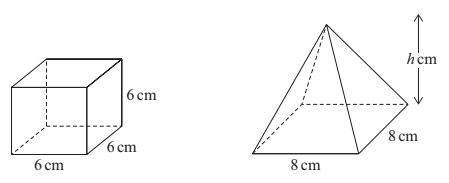
Work out the perpendicular height, h cm, of the pyramid.
Exam Alert: Questions combining 3D shapes and equating their volumes are common in GCSE Maths, especially on the AQA, Edexcel, and OCR papers. They test your ability to recall volume formulas, substitute values correctly, and solve the resulting equation. Let's break down a classic example.
The Question
You are given:
A cube with side length 6 cm.
A square-based pyramid with a base measuring 8 cm by 8 cm and an unknown perpendicular height ( h ) cm.
A key statement: The volume of the cube is equal to the volume of the pyramid.
Your task: Work out the perpendicular height, ( h ), of the pyramid.
Step 1: Visualising the Problem
It always helps to sketch the shapes, even if the exam paper provides a diagram. Here’s a simple representation of what we’re dealing with:
flowchart TD
    A["Start: Two 3D Shapes"] --> B["Cube"]
    A --> C["Square-Based Pyramid"]
    B --> D["Side = 6 cm"]
    C --> E["Base: 8 cm × 8 cm, Height = h cm"]
    D --> F["Volume of Cube"]
    E --> G["Volume of Pyramid"]
    F --> H["Key Condition:, Volume Cube = Volume Pyramid"]
    G --> H
    H --> I["Form an equation"]
    I --> J["Solve for h"]
Step 2: Recall the Essential Formulas
You must know these volume formulas for your GCSE:
Volume of a cube (or any cuboid):
Vcube = side × side × side = side³
Volume of a pyramid:
Vpyramid = 13 × area of base × perpendicular height
Crucial note: The height must be the perpendicular height from the apex to the base. For our square-based pyramid, the base area is simply side × side.
Step 3: Calculate the Volume of the Cube
Substitute the given side length into the cube formula:
Vcube = 6³
Vcube = 6 × 6 × 6 = 216
So, the volume of the cube is 216 cm³.
Step 4: Write an Expression for the Volume of the Pyramid
First, find the area of the square base:
Base Area = 8 × 8 = 64 cm²
Now, apply the pyramid volume formula. The volume is:
Vpyramid = 13 × 64 × h
Vpyramid = 64h3
Step 5: Apply the "Equal Volumes" Condition and Solve
The question states: ( Vcube = Vpyramid )
Therefore:
216 = 64h3
This is now an equation in ( h ). Let's solve it step-by-step.
Step 5.1: Multiply both sides by 3 to eliminate the fraction.
216 × 3 = 64h
648 = 64h
Step 5.2: Divide both sides by 64 to isolate ( h ).
h = 64864
Step 5.3: Simplify the fraction. Both numerator and denominator are divisible by 8.
h = 648 ÷ 864 ÷ 8 = 818
h = 10.125
Step 6: State the Final Answer with Units
The perpendicular height of the pyramid is:
h = 10.125 cm
You could also leave the answer as the exact fraction ( 818 ) cm, which is often preferable unless the question specifies a decimal.
Common Pitfalls and Exam Tips
Using the wrong height: For the pyramid volume, you must use the perpendicular height, not the slant height.
Forgetting the (13): The factor of (13) in the pyramid formula is easily missed. Remember: Pyramid volume is one-third of the corresponding cuboid's volume.
Incorrect base area: For a square-based pyramid, ensure you calculate the area (side²) correctly.
Algebraic errors: When solving ( 216 = 64h3 ), a common mistake is to incorrectly multiply or ÷. Take it slowly.
Units: Always include units (cm for height, cm³ for volume) in your working where appropriate, and definitely in your final answer.
Why This Question is Important
This problem is a great example of a multi-topic question at GCSE. It tests:
Geometry: Knowledge of 3D shapes and their properties.
Number: Arithmetic with fractions and decimals.
Algebra: Forming and solving an equation from a worded condition.
Mastering this type of question builds confidence for the longer, more complex problems found in Papers 2 and 3.
Try a Similar Question (Self-Test)
> A cube has a side length of 5 cm. A square-based pyramid has a base of 7.5 cm by 7.5 cm. If their volumes are equal, what is the perpendicular height of the pyramid?
(Answer at the bottom of the post.)
Final Thought: Always break 3D problems down into clear steps:
- Sketch,
- Write formulas,
- Calculate known parts,
- Form an equation,
- Solve.
This structured approach turns a daunting 3D problem into a manageable sequence of calculations.
- Answer to Self-Test:
- ( Vcube = 125 cm³ ).
- ( Base Area = 56.25 cm² ).
- Equation: ( 125 = 13 × 56.25 × h ).
- Solving gives ( h = 125 × 356.25 = 37556.25 = 6.\dot{6} cm ) or ( 203 cm ).